
AYURVEDABILITY · MARMA STUDY 01
Talahridaya
The center of the palm and the sole
Start with a location you can picture. Talahridaya is a paired hand-and-foot marma: one in each palm and one in each sole, making four sites in the classical count.
Remember it: middle digit → center of the palm or sole. Talahridaya is not the thumb web and not the wrist.
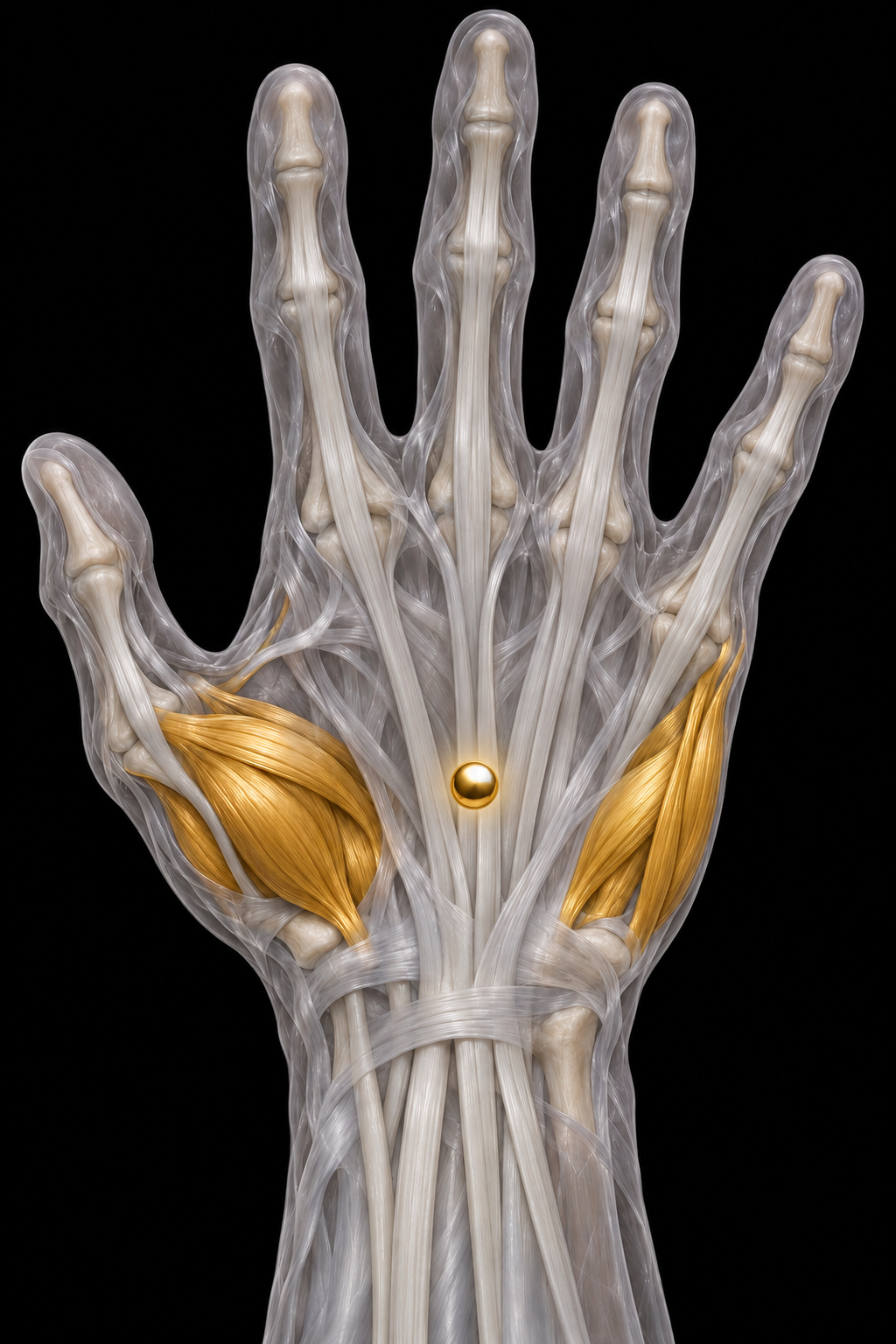
Follow the middle finger into the central palm. The gold point marks the study region between the two muscle mounds.
Find the region
Hand · palm facing up
Open the hand comfortably. Follow an imaginary line from the middle finger into the central palm, between the fleshy thumb mound and little-finger mound. This is the general study region, rather than a single crease intersection.
Landmarks: middle finger, central palm, thenar and hypothenar eminences.
Foot · sole facing you
Identify the middle (third) toe. Follow its line back into the central sole. The classical description uses the middle of the sole in line with that toe; it does not place the point at the heel or between the first two toes.
Landmarks: third toe, ball of the foot, central sole, heel.
The limb locations and four-site count follow Sushruta Samhita, Sharira Sthana 6. These are regional landmarks, not a validated millimeter-precise anatomical coordinate.
What is nearby?
Learn the tissue layers without assuming that one modern structure is the marma.
In the central palm
The palmar aponeurosis is a strong fascial layer. Deep to it are the superficial palmar arterial arch and the long finger-flexor tendons, with digital nerves and vessels traveling toward the fingers. Their positions vary across the palm and between people.
Anatomy: hand volar arch arteries · Hand flexor tendons and sheaths
In the central sole
The plantar aponeurosis covers the central compartment. Under it lie flexor digitorum brevis and deeper toe-flexor structures. Medial and lateral plantar nerve branches supply the sole.
The classical Ayurvedic description
Mamsa marma: Talahridaya belongs to the muscle/flesh category. The traditional extent is one-half angula, a body-relative finger-breadth measure, rather than a fixed number of centimeters.
Kalantara-pranahara: the classical injury classification describes potentially fatal consequences developing after severe injury. This is a historical trauma classification, not a prediction about ordinary touch or a claim of therapeutic benefit.
Source: Sushruta Sharira Sthana 6, text and commentary. Classical categories and nearby modern anatomy describe different frameworks.
A one-minute learning pass
- Look at one palm and identify the middle-finger line.
- Look at one sole and identify the third-toe line.
- Say: “Four sites, central palm and sole, mamsa marma.”
- Compare with the wrist region on the Manibandha page →
For this pass, identify the region visually or with a light resting fingertip. There is no need to dig into the palm or sole, seek a tender spot, or press on a nerve or vessel.
Check your recall
How many Talahridaya sites are counted?
Four: two palms and two soles.
Which digit helps you remember the location?
The middle digit: middle finger for the palm, third toe for the sole.
Is Talahridaya the same as a named artery, tendon or nerve?
No. Those structures help you understand the region. They do not establish a one-to-one anatomical identity for the classical marma.
Study focus: location, landmarks, tissue layers and traditional classification. No symptom-treatment claim is made here.