
AYURVEDABILITY · MARMA STUDY 02
Manibandha
The wrist-joint region
Manibandha is the marma at the junction of the hand and forearm. There is one on each side: two sites in the classical count. Think of a joint region, rather than a tiny point on a tendon.
Remember it: Manibandha = wrist. Talahridaya = center of the palm. Gulpha is the corresponding ankle-region name in the lower limb.
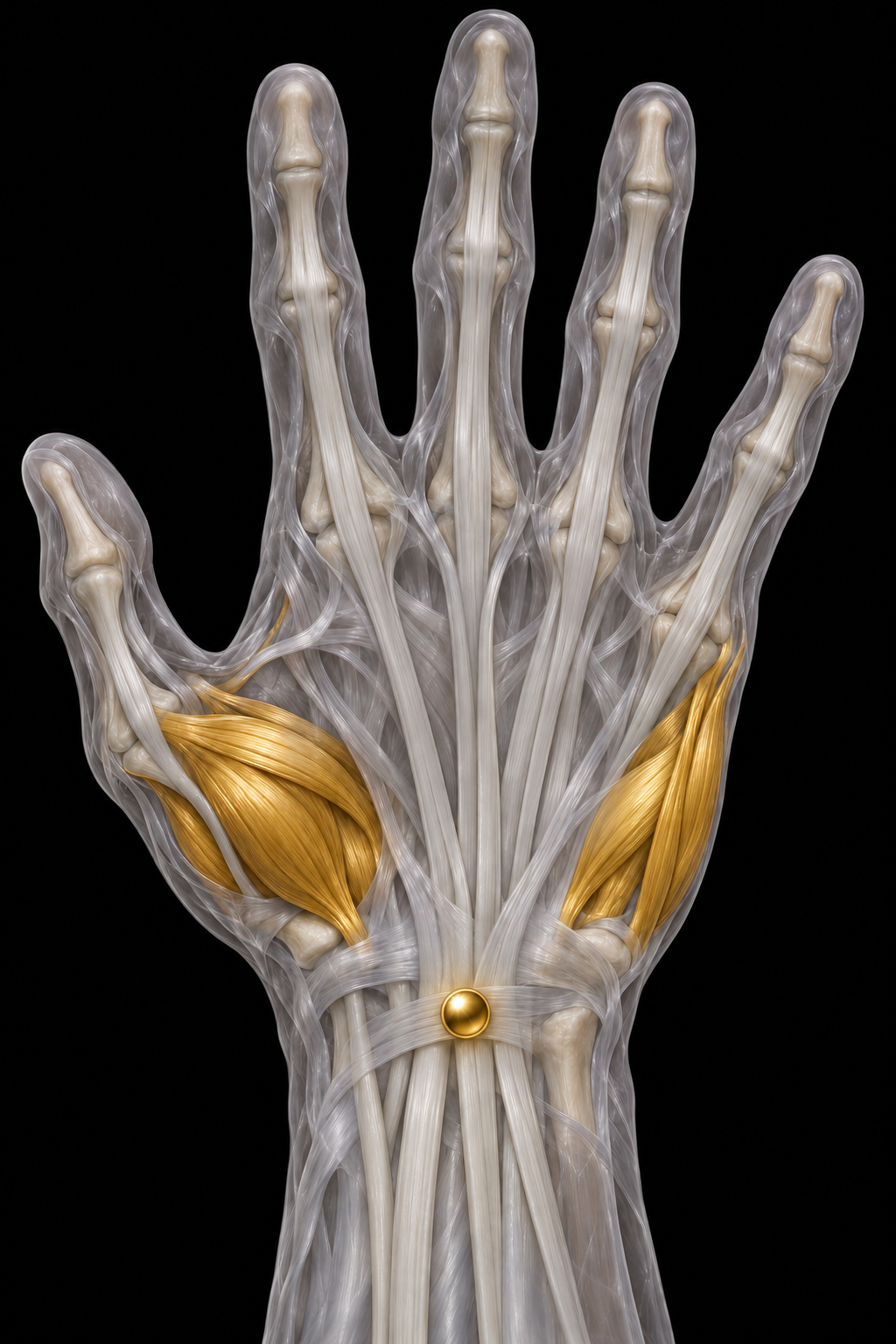
The gold point marks the junction of hand and forearm, below the palm. Compare this lower position with Talahridaya in the central palm.
Find the region
Orient yourself
Rest the forearm with the palm facing up. Identify where the hand joins the forearm. The skin creases help you recognize the region, but a crease is not an exact map of the underlying joint line.
Turn the hand over and notice that the wrist continues around the back and both sides. Manibandha names the wrist-joint region, not just the central front crease.
Useful landmarks
- Radial side: the thumb side, near the distal radius and radial styloid.
- Ulnar side: the little-finger side, near the distal ulna and ulnar styloid.
- Carpus: the small wrist bones immediately beyond the forearm.
Classical location: Sushruta Samhita, Sharira Sthana 6. Modern regional landmarks: Wrist joint anatomy.
What is nearby?
Joints and supporting tissues
The radiocarpal articulation links the distal radius and articular disc with the proximal carpal row. The midcarpal joint lies between the carpal rows. Capsules and ligaments support the wrist while allowing bending and side-to-side movement.
The ulna does not directly articulate with the carpal bones; the articular disc lies between them.
Tendons, nerves and vessels
On the palm side, the carpal tunnel contains the median nerve and nine flexor tendons beneath the flexor retinaculum. The ulnar nerve and artery take a separate route on the little-finger side. The radial artery is on the thumb side.
These are neighboring structures, not proof that Manibandha is a single nerve, artery or carpal-tunnel point.
The classical Ayurvedic description
Sandhi marma: Manibandha belongs to the joint category. Its traditional extent is two angulas, using a body-relative finger-breadth measure, not a universal centimeter value.
Rujakara: Sushruta groups Manibandha among marmas associated with pain after injury. This classification concerns the vulnerability of an injured region; it is not evidence that pressing the region treats pain elsewhere.
Source: Sushruta Sharira Sthana 6: structural, injury and size classifications. The classical category and the modern anatomical description are kept distinct.
A one-minute learning pass
- Locate the hand–forearm junction on each side.
- Name the thumb side “radial” and the little-finger side “ulnar.”
- Say: “Two sites, wrist joint, sandhi marma.”
- Compare it with Talahridaya in the central palm →
Use observation or a light resting fingertip to learn the landmarks. Do not use deep pressure over a pulse or the carpal tunnel, and do not try to reproduce tingling or numbness.
Check your recall
What is the simplest location cue?
The wrist-joint region, where the hand and forearm meet.
What does sandhi tell you?
It is the classical joint category. Manibandha is counted once at each wrist.
Does the ulnar nerve pass through the carpal tunnel?
No. The median nerve passes through the carpal tunnel. The ulnar nerve takes a separate route on the ulnar side of the wrist.