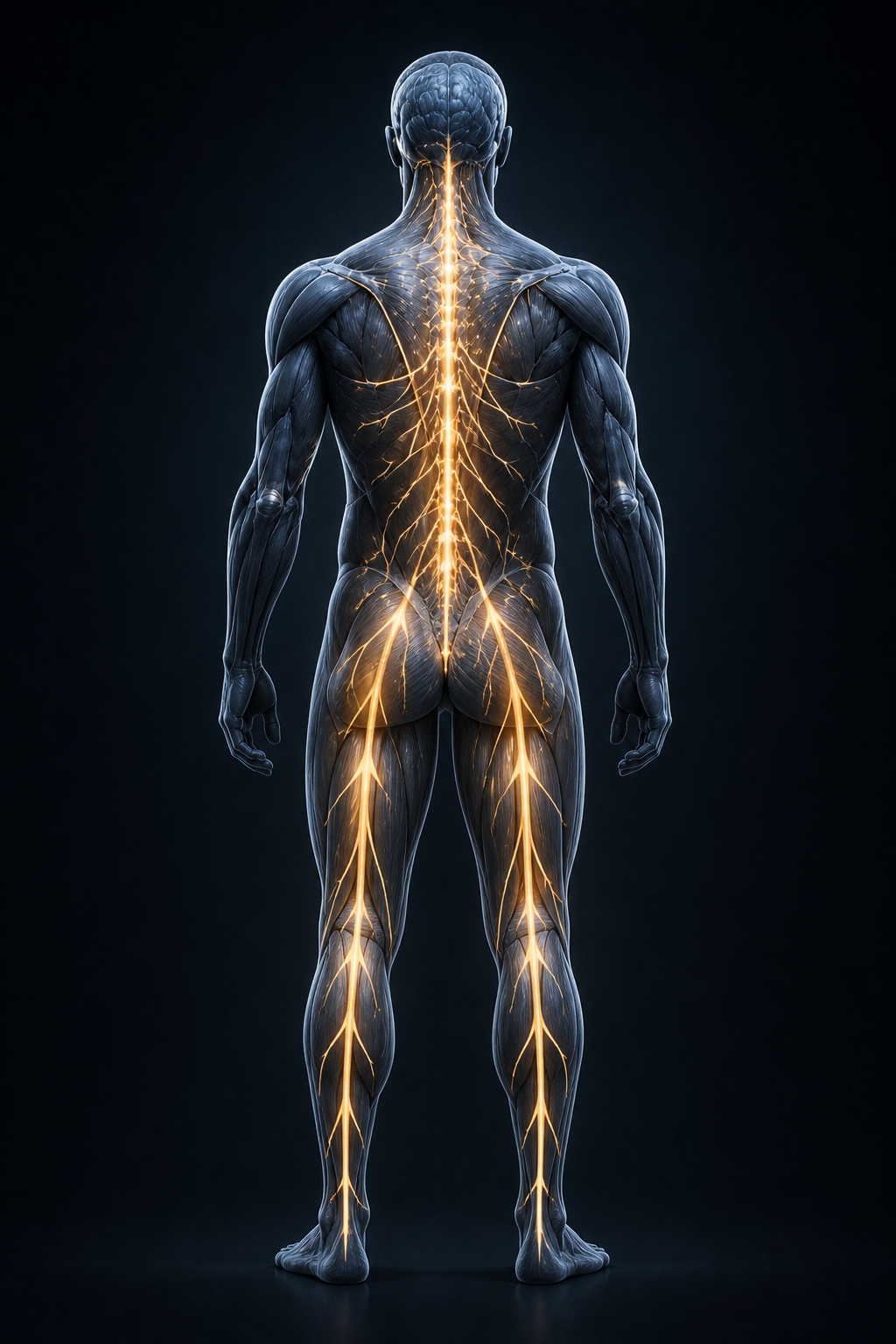
UNDERSTAND THE LANGUAGE OF LOAD PATHS
“Applied” Myostability Concepts - The Logic and Applicability of Load Path Names
1. Start with what you feel in the muscles.
When tension is present in a muscle or across multiple areas, it reflects a pattern of tone, not a single muscle issue.
2. That tone can remain after the load is gone.
Muscle activity doesn’t always return to a lower tone after stimulus is gone.
The pattern you feel may persist even when the original demand is no longer present.
3. The first word names where that increased tone is expressed.
It identifies the region where this pattern shows up on palpation. It may also be present in where someone “feels tight.”
4. The second word defines the role of that increased tone.
Terms such as “Control” and “Counterbalance” indicate how this tone is part of the nervous system’s response to load demand—not the origin of it.
5. “Load path” describes gravitational pull through the body, and how the nervous system responds to that pull.
It refers to how load was distributed through the system—not a physical structure.
6. Read the pattern, not the spot.
A consistent pattern of tone reflects how the system has been organizing to manage load—not where the problem started.
What you feel is often the after-effect of how load was managed—not the load itself.
The nervous system organizes the body according to load demands. This naming system helps you see how and why.
Introducing the Unloaded Position
-
This refers to the body in a prone position (laying flat on a surface, face up) with no meaningful load demand. Nothing is being asked of the system.
-
No story. No intention. No diagnosis. This is simple, like a computer. “If this - then that” is a key frame of mind when thinking about how the body is organized under load.
Example: When you pick up a bucket with the left hand, there is an increased gravitational pull through that left hand and upward into the body. The nervous system simply adjusts for that increase in load demand.
-
This model does not use discipline-specific language.
These types of terms are not used here:
compensation
guarding
protection
imbalance.
These are interpretations — not physiology.
Why this matters?
Those words mean different things to different people. They describe what someone thinks is happening — not what can be clearly communicated or observed.
The Myostability Model gives everyone a physiological way to talk about pain.
Instead of guessing or interpreting, anyone then can describe:
where increased tone is present
how it changes
how the system responds to load
Clear. Consistent. Observable. Applicable to every discipline and everyday life.
-
Many sayings sound meaningful but they are not true to physiology. Muscle activity changes based on input from the nervous system.
You may have heard or read that
“You carry your stress in your shoulders”
“Trauma is stored in this muscle”
“Grief is in the low back”
These are common sayings meant to describe feelings. They are not physiology — they are only metaphors.
What is actually happening?
Muscle activity changes based on input from the nervous system and is often felt as a sensation of tension, release, or changes in the ability to move. -
We start with a simple mental picture:
Someone lying face up, with no meaningful load.
From here, we begin adding load in different ways to see how the nervous system responds.
There is still some load in this position — but it is minimal.
This is our starting point.

EXAMPLES OF LOAD PATHS
Anterior Control Load Path
Tone palpated along the anterior aspect of the body is often a response to increased forward gravitational demand - in other words increased tension in the front is likely to keep you from falling forward.
Example Muscle: Anterior Tibialis
Unloaded
POSTERIOR COUNTERBALANCE LOAD PATH